

When Workers Pushed Back
From Haymarket to Today, the Fight for Fair Wages, Dignity, and a Share of America’s Prosperity Never Truly Ended.

It is the duty of every patriot to protect his country from its government.
— Thomas Paine
Dear Friends,
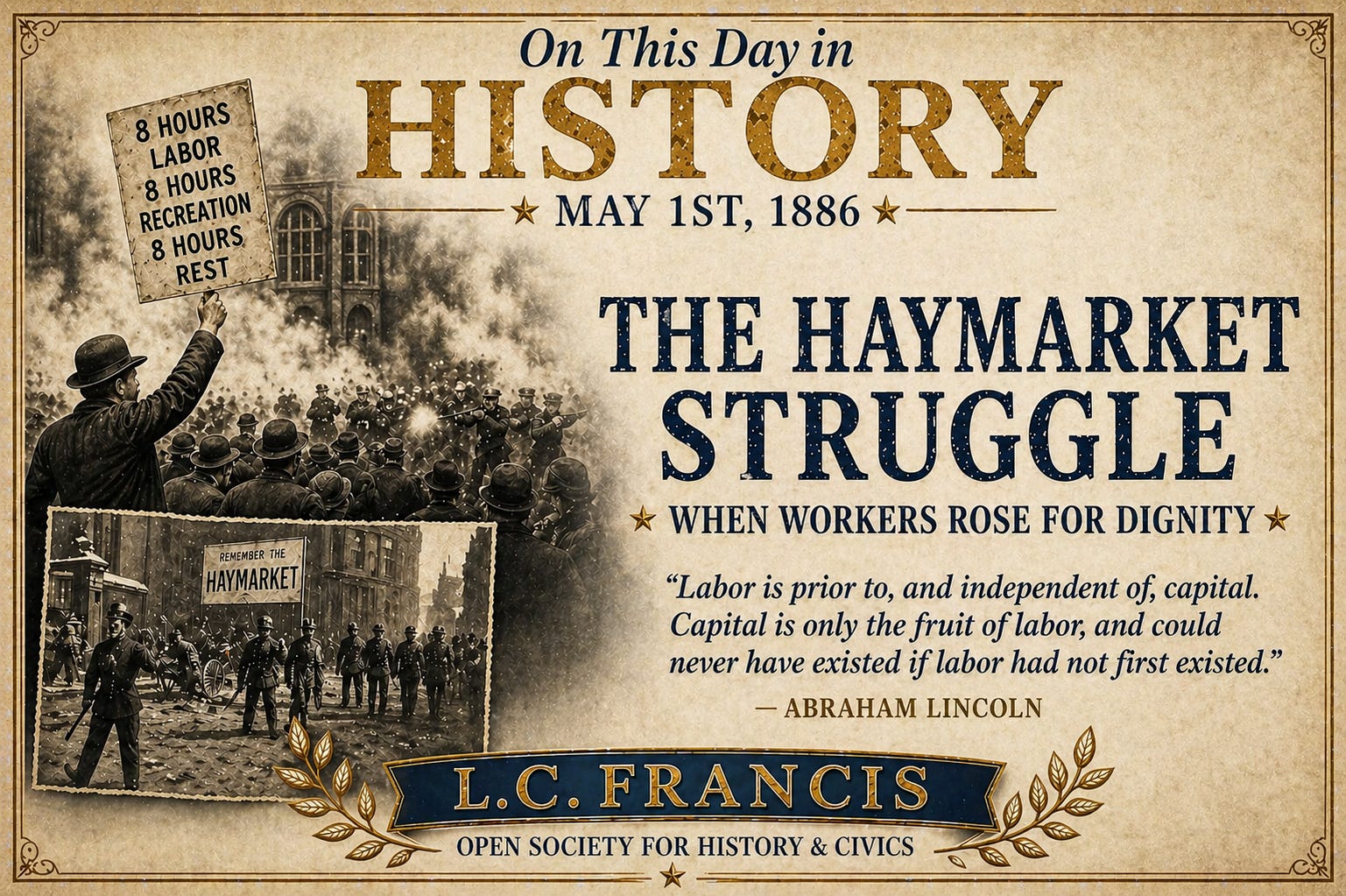
On May 1, 1886, hundreds of thousands of hardworking Americans came together, taking to the streets to advocate for an eight-hour workday. In vibrant cities like Chicago, New York, Milwaukee, and Cincinnati, factory workers, railroad employees, laborers, and tradespeople, along with their families, marched proudly, waving banners and enjoying lively brass band music. Their call was not for special favors, but for the simple dignity of having enough time to live a humane and fulfilling life.
To grasp the power of that day, you must understand the life they were escaping.
Back in industrial America, workers often faced long days, sometimes ten, twelve, or even fourteen hours, with six-day workweeks being the norm. Children also worked in mills and mines. Accidents happened regularly, safety measures were quite limited, and wages often didn't quite cover the essentials. When a worker lost a hand, a leg, or their health, companies usually moved on swiftly, leaving families to manage on their own. Despite the wealth being created, millions of industrious individuals were living on the brink of exhaustion, trying to keep everything afloat.
That spring, labor groups launched a nationwide effort to make an eight-hour workday the norm. About 300,000 workers took part in strikes or protests. For many Americans, it was the first time ordinary citizens organized on such a large scale to call for a fairer distribution of prosperity.
Chicago emerged as the focal point of the struggle.
After several days of labor unrest and police violence, a rally took place at Haymarket Square on May 4. When police stepped in, a bomb was thrown, and gunfire broke out, resulting in casualties among officers and civilians. The identity of the bomber stayed unknown, but the public reaction was quick and passionate. Labor leaders were detained, which led to controversial trials, and a few men were executed despite serious doubts about the evidence.
The pattern remained clear: whenever workers resisted concentrated wealth, the public debate moved from issues of wages and conditions to themes of fear and chaos.
Yet the broader cause endured.
Over the following decades, Americans achieved important milestones like the eight-hour workday, overtime rules, weekends, workplace safety standards, pensions, and collective bargaining rights. These achievements weren't simply given by kind-hearted business leaders; they were earned through strikes, organization, political advocacy, and sacrifice. Labor unions were essential in building the largest middle class the world has ever seen, showcasing the power of unity and perseverance.
Then, the tide shifted.
Back in the 1950s, roughly one in three American workers was part of a union. Today, that number has dropped to around 6 percent in the private sector. When unions grew weaker, wages didn't quite keep up with how much workers could produce. Since the late 1970s, worker productivity has risen significantly, but for many employees, their hourly pay, adjusted for inflation, has increased only slightly. Meanwhile, the pay for top executives has shot up dramatically. CEOs at big companies now often earn hundreds and sometimes thousands of times more than the typical worker.
The wealth gap tells the story clearly.
While the wealthiest Americans amass trillions in wealth, it's quite eye-opening that many full-time workers still find it challenging to handle a $1,000 emergency without taking on debt. Many people are juggling multiple jobs, and in many areas, housing expenses have grown faster than wages. Families also face heavy healthcare costs, and childcare in some states now costs as much as college tuition. At the same time, some big corporations report record profits but resist union efforts in warehouses, coffee shops, retail outlets, and logistics centers.
That resistance is not just theoretical.
Recent efforts by workers to organize have encountered many obstacles, including surveillance, mandatory anti-union meetings, or retaliatory firings that are later challenged in court. There have also been store closures following organizing efforts and lengthy legal battles that aim to drain their momentum. Unfortunately, penalties for illegal anti-union actions are often too weak, making it easier for companies to overlook them.
This isn't a free market; it's just power shielding itself.
Today, workers often carry laptops instead of lunch pails, rely on apps rather than railroads, and respond to emails at midnight instead of working by factory belts. Despite these changes, the key question from May 1, 1886, still remains: with America's wealth at an all-time high, why do so many workers feel more anxious than secure?
Because an economy can expand even as society deteriorates.
As productivity grows, employers enjoy more benefits, but workers find their bargaining power slipping away. Healthcare still relies on job security, and having a full-time job doesn't always guarantee dignity anymore. The real issue isn't laziness or a lack of effort…it's a fundamental flaw in how our system is designed.
May 1 is a heartfelt reminder that workers' rights need more than nostalgia to survive. They thrive when we get involved…by organizing, voting, speaking up for stronger labor laws, backing collective bargaining, and standing firm against the idea that exploitation somehow equals efficiency.
The workers of 1886 understood something many have since forgotten.
If a nation's builders cannot coexist with dignity, then what appears as prosperity isn't genuine shared success. Rather, it's an imbalance. A nation built on such an imbalance isn't truly stable; it's only surviving temporarily.
And let’s not forget that power brokers and the wealthy have long believed they could manage that imbalance, yet history suggests otherwise. The record, from the French Revolution to the Russian Revolution, shows that when the gap grows too wide, outcomes are rarely shaped by those who once believed they were in control. “Power to the People.”
Vivat Constitution!
If this article resonates with you or offers even a small sense of clarity, please share it with friends and loved ones who value our Republic. Also, please consider subscribing as a free or paid Open Society member; you can cancel at any time. All of this work is free and accessible to everyone, thanks to our paid members’ subscriptions, which help maintain the independence and openness that made this possible.
Thank you, LC.
"An economy can expand even as society deteriorates." - L.C. Francis
Joe Hill (activist) https://en.wikipedia.org/wiki/Joe_Hill_(activist)
Paul Robeson, "Joe Hill" https://youtu.be/n8Kxq9uFDes?list=RDn8Kxq9uFDes
Happy International Workers' Day!
Today is also the anniversary of Ford introducing the 40 hour work week and National Law Day