

Founder's Tavern Project 2026: Data Centers & The Cloud That Doesn't Make Rain
The AI boom is not floating above us; it is draining water, consuming power, and sending the bill to the public

“The public good is disregarded in the conflicts of rival parties, and measures are too often decided, not according to the rules of justice…but by the superior force of an interested and overbearing majority.”
— James Madison, Federalist Paper no.10
Dear Friends,
In Fayette County, Georgia, residents began noticing something both ordinary and alarming: their water pressure was dropping. They were told to conserve water, stop watering lawns, and do their part while the system was under strain. Later, officials discovered that a large data-center project had used roughly 29 million gallons of water through two improperly documented connections before the public fully understood what had happened. QTS said the water was used during construction, not for cooling servers, and the county eventually issued a back bill. But the deeper lesson remains: ordinary people were asked to sacrifice before they were fully informed.
That is where Founder’s Tavern Project 2026 begins.
From this point on, we'll analyze the damage to the Republic one sector at a time: data centers, education, healthcare, labor, housing, public media, environmental protection, and public systems that either serve ordinary people or quietly capitulate to private interests. We'll examine the damage and the consequences, and propose tangible solutions backed by real data, because self-governance can't rely on slogans, vibes, or press releases. It demands citizens who can follow the water line, power line, tax breaks, and bills.
Data centers are the right place to begin because they expose the lie behind one of the most comforting phrases in modern life: “the cloud.” There is no cloud. There is land, concrete, steel, fiber, substations, transmission corridors, backup generators, cooling systems, water withdrawals, zoning fights, tax incentives, and local officials being told that if they ask too many questions, the next county will gladly take the deal. The promise lies in digital progress, but the reality involves physical extraction.
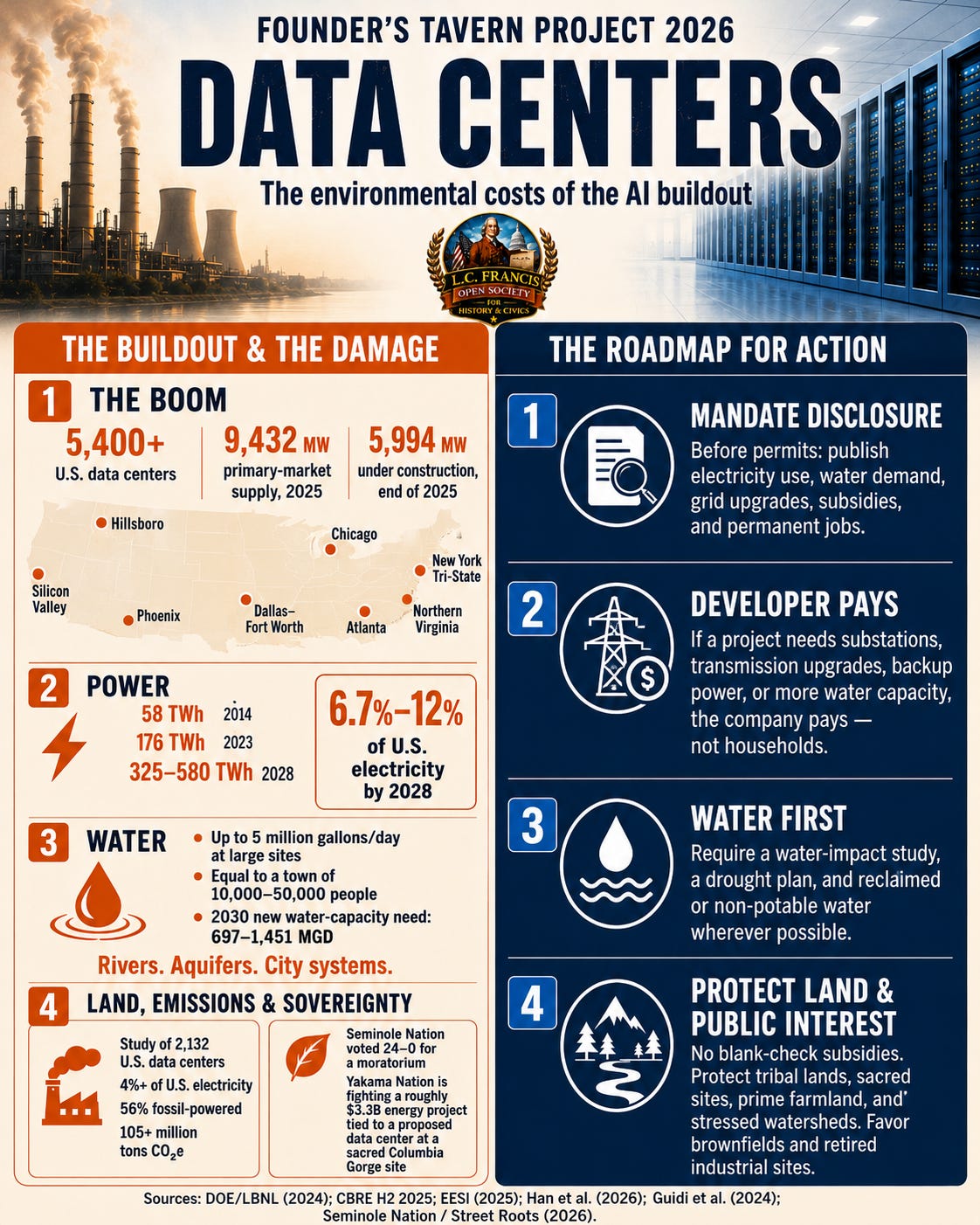
The scale has expanded significantly. The United States now hosts over 5,400 data centers. In 2025, North America’s key data-center hubs had a supply of 9,432 megawatts, with approximately 5,994 megawatts still under development at year's end. These hotspots are real, including Northern Virginia, Dallas-Fort Worth, Silicon Valley, Chicago, Phoenix, Atlanta, Hillsboro, and the New York Tri-State area. This isn't just a small upgrade to the internet; it represents a whole new industrial landscape emerging over the old civic framework.
The electricity consumption figures should alarm every governor, county commissioner, school-board member, and state legislator in America. In 2014, U.S. data centers used about 58 terawatt-hours of electricity. By 2023, this number increased to 176 terawatt-hours. The forecast for 2028 predicts usage between 325 and 580 terawatt-hours, accounting for roughly 6.7% to 12% of all U.S. electricity. Essentially, a private race for AI capacity could soon consume a significant share of the national grid, influencing household bills, infrastructure development, and environmental policies across the country.
Water usage brings the story from a futuristic scenario to a local concern. Large data centers can consume up to 5 million gallons of water daily, roughly equivalent to the daily water use of a town with 10,000 to 50,000 residents. If current trends persist, U.S. data centers may need between 697 and 1,451 million gallons of additional daily water capacity by 2030. This issue extends beyond engineering; it is a democratic concern: in times of drought, who gets priority…the families and farms or the server farms?
The story of emissions remains equally critical. A 2024 study analyzing 2,132 U.S. data centers found they use over 4% of the country's electricity, with 56% of that coming from fossil fuels, and they produce more than 105 million tons of CO₂-equivalent emissions. At the same time, the issue of sovereignty is tangible. In 2026, the Seminole Nation of Oklahoma unanimously voted for a moratorium on generative AI and large-scale data-center projects within its territory, while the Yakama Nation has opposed a nearly $3.3 billion energy project associated with a proposed data-center at a sacred site in the Columbia Gorge. This illustrates how innovative language can clash with the long-standing American tendency to treat others’ land as unoccupied.
So Project 2026 begins with a question every household understands: Who pays for this? A giant data center does not arrive with a few servers and a ribbon-cutting ceremony. It often arrives needing new power lines, new substations, backup systems, water capacity, road access, emergency planning, and sometimes special tax treatment from the same public officials who tell residents there is not enough money for schools, roads, public health, or clean water.
Before any permit is approved, every developer should be required to publish a plain-language cost sheet. How much electricity will the project use? How much water will it draw? What new infrastructure is required? What public subsidies are requested? How many permanent jobs will be created after construction ends? Who pays if the water system, power grid, or emergency services must be expanded? If the company cannot answer these questions clearly, the project is not ready for public approval.
The next rule is straightforward: the developer bears the cost of the impact it causes. If a data center needs a new substation, the developer pays. If transmission upgrades are necessary, the developer covers the expenses. If additional water capacity is needed, the developer is responsible. When backup generators pose pollution risks, the developer must publicly disclose the plan and cover monitoring costs. Ordinary families, farmers, small businesses, and schools shouldn't later discover that their monthly bills secretly support the infrastructure of billion-dollar tech firms. True innovation shouldn't come at others’ expense while profits remain private.
Water should always be prioritized over promises. Every county vulnerable to drought should mandate a water-impact assessment before approval, establish drought-restriction plans prior to construction, and use reclaimed or non-potable water whenever technically feasible. While residents are advised to stop watering lawns, farmers are encouraged to conserve, and small towns are asked to tighten budgets, server farms should not be considered beyond public oversight or restraint.
Land must also hold memory. Tribal lands, sacred sites, prime farmland, and stressed watersheds are not empty spaces waiting to be developed. Local governments can halt projects while creating new zoning regulations, including cultural resource assessments, watershed reviews, public consultations, binding approvals, and penalties for developers who deceive the public. The default focus should be on brownfields, abandoned industrial sites, and already-disturbed lands, rather than sacred ground, farmland, or communities with limited political influence.
That is the Project 2026 test. Before any official votes yes, citizens should be able to ask in public: What will this project use? What will it cost? Who pays for the power lines? Who pays for the water system? What happens during a drought? What land is being disturbed? How many permanent jobs are real, not inflated for a press release? What tax breaks are being offered? What happens if the promises fail?
Self-government is returning not just as a slogan but as a practical checklist for citizens. It happens when county commissioners realize they are under scrutiny, when candidates are compelled to respond before elections, when governors can't hide behind ceremonial events, and when local councils, school boards, and independent journalists have access to the data. The cloud is not looming above; it is being constructed alongside us, through our grids, across watersheds, on our land, and sometimes with our own funds.
If digital infrastructure is truly necessary, then let it prove itself in daylight. No secret water deals. No hidden grid costs. No tax breaks without an enforceable public benefit. No sacred land is treated as vacant acreage. No community told to conserve while a server farm drinks first. No family should pay higher utility bills so a billion-dollar company can build faster, profit sooner, and leave the public holding the debt.
This is not opposition to technology; it is a matter of self-governance. And it is exactly what I call “constitutional maintenance.”
As we near the midterms and beyond, fellow citizens must stay informed with facts, our communities should avoid becoming sacrifice zones, and public officials need to remember they are elected to serve the commonwealth…not to sell it off, whether it's a megawatt, an aquifer, a tax break, or an ancient burial site.
Vivat Constitution!
If this article resonates with you or offers even a small sense of clarity, please share it with friends and loved ones who value our Republic. Also, please consider subscribing as a free or paid Open Society member; you can cancel at any time. All of this work is free and accessible to everyone, thanks to our paid members’ subscriptions, which help maintain the independence and openness that made this possible.
Vital issue. Greensboro, NC is building its first data center and our local climate group is scrambling. This is an international issue, not just a local one, and developers like those in Vail, Colorado have proved to be ruthless. Alarum!
Very good L C.
No secret deals.
No “hidden” costs.
The developer is responsible for all consequential costs.
The so-called AI boom & its public/private costs needs to be part of the larger political discussion.
The TechBros cozying up to various political figures has nothing to do with ideology & everything to do with dollars & cents.
We should be wary of the golden promises of wealthy corporations.
Their destructive potential is immense.
& we’ll be stuck with the bill.
& finally, it’s Not AI. W/O a singularity it’s just massive & massively smart computers
& the “trainers” cultural biases are implicitly suspect.
They are not “neutral.”
Resist
Avance la Lucha